
256-bit keys
A large key space provides a strong foundation for resistance to exhaustive key searches.
Student records, everyday school work and agency collaboration all depend on thoughtful protection of information.
Explore security practicesEvery relationship deserves care.
01We use 256-bit keys to encrypt data requiring protection, alongside access controls and key management to support confidentiality for schools and organisations.
256-bit keys · Symmetric encryption
A large key space provides a strong foundation for resistance to exhaustive key searches.
AES is defined in NIST FIPS 197, with a public specification and established implementations.
Encryption transforms readable information into ciphertext, protecting its contents from those without the correct key.
Symmetric encryption suits larger volumes of data and can benefit from optimised software and hardware implementations.
Encryption protects content, access controls define permissions, and key management supports secure use. Together, they bring data protection into everyday operations.
Explore the AES standard ↗The Beiyou Intelligent University Guidance SaaS System holds a filing certificate recording Level 2 information-system security protection.
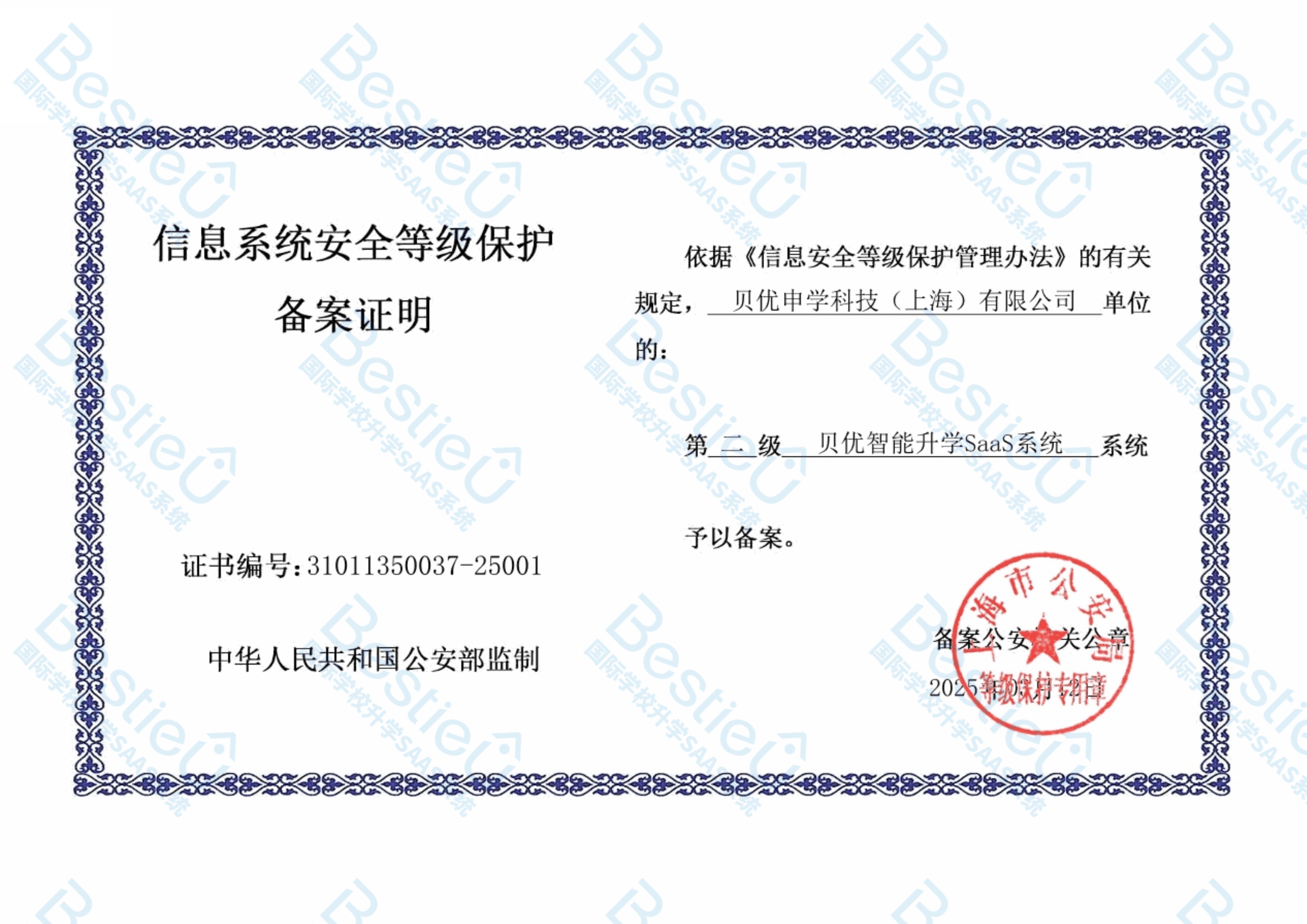 View original certificate
The filing covers the system named above. Contact Beiyou for assessment records, deployment scope or security evaluation materials.
Request security evaluation materialsChina’s graded security protection framework assigns protection levels according to a system’s importance and the impact of disruption. These levels guide security measures, management, assessment and remediation. Filing is one part of this process and records the entity, system and protection level.
Read the official security protection rules (Chinese) ↗This document records the named system’s Level 2 filing. A filing certificate and a security assessment report serve different purposes. Product evaluation can also review assessment records, deployment arrangements and ongoing security management for the relevant system.
Make the purpose, access boundaries and responsibilities clear, from collection and use to backup and subsequent handling.
Define purpose and necessary data
Review connections and protection
Check hosting, encryption and backups
Assign access by role
Agree retention, exports and deletion
Features, hosting, backups and support arrangements depend on the selected product and service agreement.
Explore BestieU’s security practices and the details to confirm when evaluating a product.
Give people access appropriate to their responsibilities.
BestieU offers single sign-on and two-step verification options. Identity-platform connections depend on the product version, supported protocols and configuration.
Configure viewing, editing and administration around each role and the access it needs. Review and revoke access as responsibilities change.
Consider people, networks and devices when managing access, including protection for mobile work. Confirm supported policies and devices for the selected product.
Agree the scope, responsible staff and task when support requires system access. Avoid handing over shared accounts or passwords.
Consider how data moves and how it can be recovered.
Protect data in transit and storage with encrypted communications and safeguards for sensitive information. Confirm covered fields, key management and responsibilities for the chosen deployment.
Plan data protection around snapshots, off-site backups, monitoring and recovery testing. Agree backup frequency, retention and recovery objectives in the service plan.
Define cloud resources, network isolation, gateways and access controls around operational needs. Hosting locations and resources depend on the product.
Review permissions and processes for exports, sharing, device use and the data lifecycle. Explore the use of protective measures such as watermarks during a product demonstration.
Bring security considerations into development, releases and support.
Define security requirements throughout development, pre-production and production. Discuss security checks and release validation during evaluation.
Use scanning, risk identification and follow-up processes to track security issues. Evaluation can clarify prioritisation, ownership and how remediation is verified.
Establish clear processes for incident response and follow-up. Preserve relevant details and contact the responsible team when an issue occurs. Response times, escalation and notifications follow the service agreement.
Evaluate public-cloud SaaS and dedicated deployment options against your needs. Agree operational ownership, migration, access management and ongoing support when selecting a solution.
Explore Beiyou’s information security management and certification records.
Refer to the certificate for its holder, validity and scope. Contact Beiyou for the latest documentation.

Functionality, deployment and certification scope vary by product. Work with the team to confirm the security configuration and service plan for your selected product.
Contact the team with your product, organisation type and evaluation topics. This page and the About page display the named Beiyou SaaS system’s Level 2 filing certificate alongside related certification records. Contact the team for additional evaluation materials and scope.
Existing customers should use their product support channel. You can also use the contact route below to identify the product, timing and observed issue. Do not include passwords, full student records or unrelated personal information in an initial report.
Contact the team to evaluate a product, clarify data responsibilities or report an issue.
Include the product, organisation, timing and observed issue. Do not send passwords, full student records or unnecessary personal information in an initial report.